
Calabasas Resident Lookup Sources
A useful Calabasas resident lookup starts by naming the question. A parcel search can confirm that land exists and can expose an AIN, situs and building facts, but the county Assessor Portal does not show owner names online. A deed supplies grantor and grantee names, yet a grantee is not proof of occupancy. Voter verification is for a person checking a registration, not for browsing a block. Court records show a party role and case events, while vital records link people through a regulated event. The table keeps those roles separate.
| Record | What It Confirms | Where | Access |
|---|---|---|---|
| Assessor parcel | Parcel facts and current characteristics; owner through a separate channel | LA Assessor Portal | Free map and address search; no owner name online |
| Recorded deed | Named grantor, grantee, transfer and legal description | LA County RR/CC | 1851-present office index by name and year |
| Voter record | Registration or status for an exact person | LA County voter verification | Restricted purpose; self-tool needs DOB and address fields |
| Court case | Party role, filing, hearings, events and disposition | LA Court Find a Case | Case number access, paid remote name search, free courthouse terminal |
| Vital record | Birth, death, marriage or family link | California Vital Records | Authorized and informational copies follow eligibility rules |
| Business or license | Entity, professional status or public filing tie | DCA Search and bizfile | Free public indexes; a business address may not be a home |
| Probate filing | Decedent, fiduciary and possible heir clues | LA Superior Court | Public portions only; sensitive filings remain restricted |
If an address is known, capture its AIN and situs first, then use an authorized owner channel before moving to the deed index. If only a name is known, court and license indexes can separate namesakes, but each hit needs a second record. For family work, probate, obituaries and vital indexes may connect generations without exposing a protected address. A focused request to the agency that holds a record is stronger than asking any office to investigate a person.
Calabasas Resident Court Search
Calabasas cases are handled by the Superior Court of California, County of Los Angeles. The Find a Case gateway separates free case-number access from paid party or defendant name searching. Civil, criminal, family, probate and small claims cases have different public views. A first-time remote user signs in or continues as a guest. Courthouse public kiosks provide name-search functionality without the remote cost-recovery fee, which makes the terminal the practical route when a name search does not need to be run from home.
| Search or control | Type | Required or result |
|---|---|---|
| Case Access: case number | Text | Required for free direct case lookup |
| Case Calendar: case number | Text | Required for a calendar search |
| Case Document Images | Account or guest workflow | Civil limited or unlimited and small claims; paid per image |
| Search by party or defendant name | Separate service | Paid online; criminal, civil, family and probate variants |
| Sign in or Guest | Buttons | Required for fee-bearing remote services |
Guest party searches cost $4.75. Registered pricing is $1 for searches 1-10 in a month, $4.75 for 11-99, $4.50 for 100-999, $4.25 for 1,000-10,000, and $4 for 10,001 or more. A fee applies even when there is no match. Online images cost $1 per page for pages 1-5, then $0.40 per page, with a $40 maximum per document. A staff index search that takes more than ten minutes can cost $15 under Government Code section 70627(c).
The court's official fee page shows how a paid search and a document request differ. Review the Los Angeles Superior Court fee information before choosing remote access.
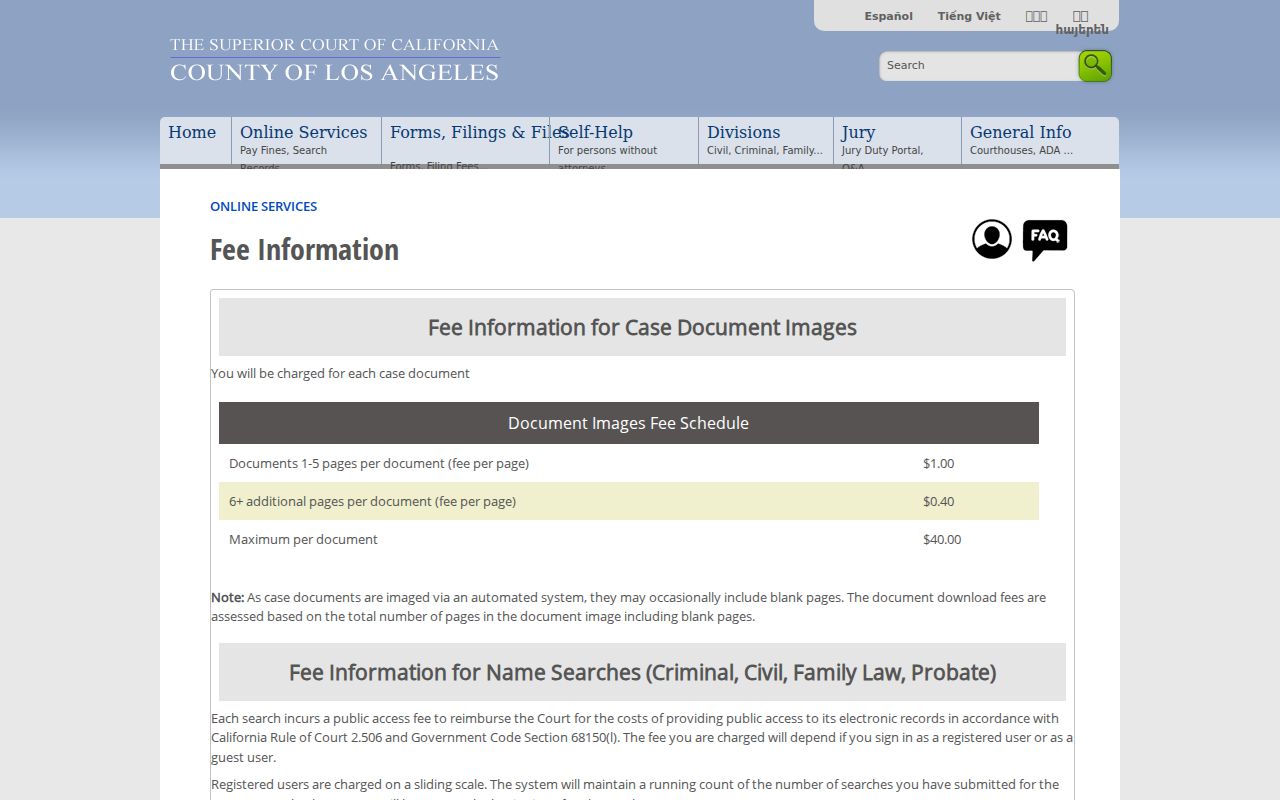
The fee schedule is a useful check on the boundary between a name search, a case lookup and a copy request.
Sample case result.
A public result commonly lists the case number, title, filing date, case type, courthouse, party names and roles, register-of-actions dates, scheduled hearings, and disposition or judgment events. Civil image links may be fee-gated. Criminal and family documents may be terminal-only, while juvenile, adoption, sealed and other confidential materials remain hidden.
- Case number and title identify the file.
- Party role helps distinguish a plaintiff, defendant, petitioner or respondent.
- Filing dates and courthouse location test whether the timeline fits the person.
- Hearings, orders and dispositions show case events, not a complete life history.
California Rule of Court 2.503 requires reasonable access but limits remote access to family, juvenile, criminal and other sensitive categories. The court index is a lead, not proof that two records belong to one person.
Calabasas Resident Namesake Checks
Same-name errors are common when a court party, deed grantee or license result is treated as a complete identity. Preserve the exact spelling, middle initial and suffix. Compare the age implied by the event, the party role, the courthouse and the record date. A deed legal description is stronger than a surname match. A business filing can separate two people with the same name, but an agent address is a business fact, not proof of a home.
California's DCA Search accepts board and bureau, license type, license number, business name, first name, last name, registry number and advanced-search controls. The result may show current or expired status and public suspension, revocation or discipline. SOS bizfile searches an entity name or file number, with contains or starts-with filters, entity type, status and initial filing date. Pair a business result with a county fictitious-business-name filing or a Calabasas permit when the research question concerns a public filing. Do not turn an occupation or company record into a residence claim.
For an older person, an obituary can connect a name to a family and former place, while probate can explain a transfer after death. For a former classmate, a yearbook or alumni collection may fit the purpose better than a current lookup. Record contradictions instead of smoothing them away, then ask the custodian to correct an official error through its own process.
Calabasas Voter Record Limits
The Los Angeles County voter tool is for self-verification. It asks for all four identity fields below, so it cannot act as a public people browser or a street-by-street roll. A match confirms registration information to the person who supplies the facts. It does not reveal ballot choices, and participation history means an election in which a person voted, never the choice marked.
| Field | Required format |
|---|---|
| Last Name | Alphabetic text |
| Birthdate | mm/dd/yyyy |
| House Number | Numbers only; residence house number |
| Zip Code | Numbers only |
| Verification control | Submits all four fields |
Elections Code section 2194 limits voter data to approved political, governmental, scholarly, journalistic or election purposes and bars commercial use. Residence address, phone, email, precinct identifiers and prior registration information have additional protection. Individual services include a $1.50 copy of one's own certified registration, a $6.75 copy for another person's public or authorized record, $6.75 voter history per name and a $5 registration-file search per name. Bulk files require a contract and an authorized purpose.
The individual request route has its own form and mail channel. Los Angeles County voter information instructions describe copies, fees and submission choices.
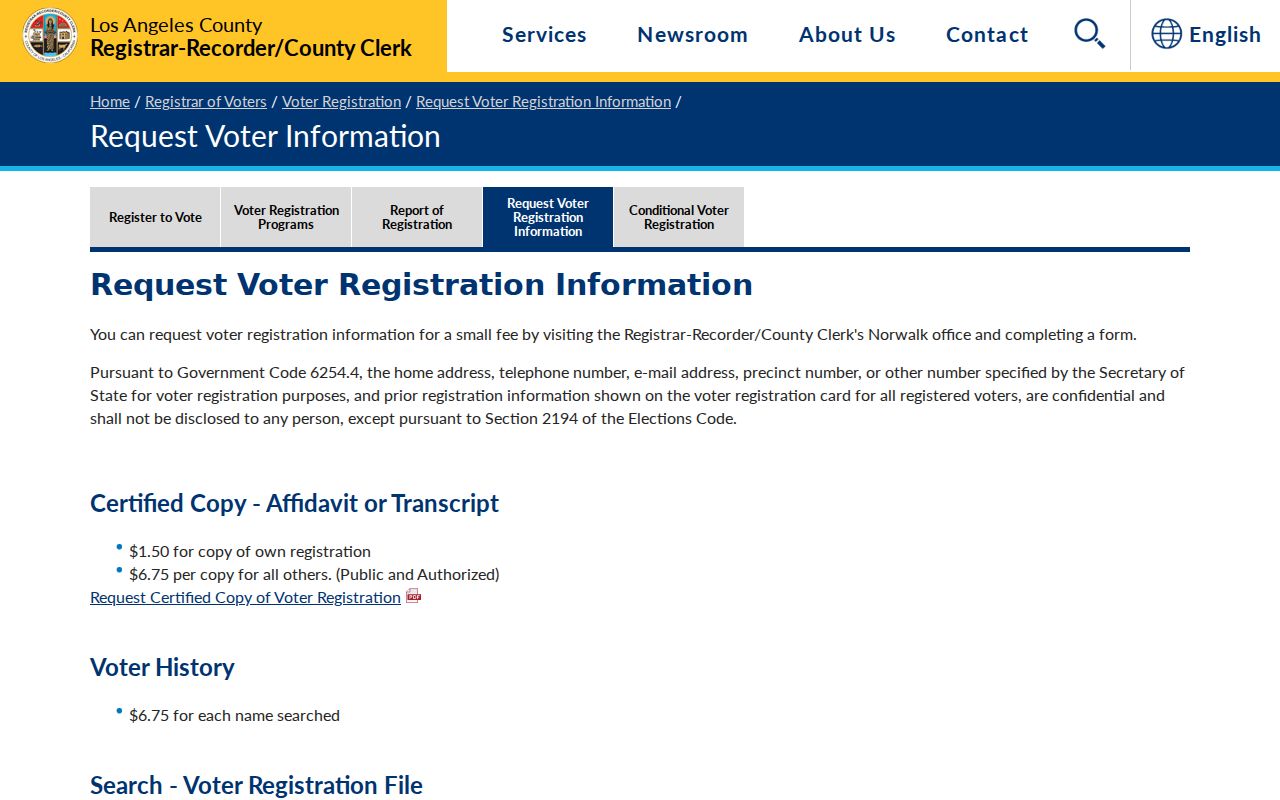
The request page reinforces that voter records must be handled for an authorized purpose rather than used to build a casual list of Calabasas residents.
Calabasas Vital Records Copies
California vital records use an authorized and informational copy system, not one simple rule that makes every certificate public after a set number of years. Health and Safety Code sections 103525-103526 limit authorized certified copies to eligible requesters. Informational copies can be ordered by the public but carry a clear legend that they are not valid to establish identity. Confidential marriages are available only to a party or by court order.
LA County RR/CC and the California Department of Public Health issue birth, death and marriage records as applicable. Divorce decrees come from Superior Court, while CDPH may issue a certificate of record for limited years. Forms ask for the record type, name on the certificate, event date and place, parents or spouse names when relevant, requester identity, relationship or eligibility category, purpose, number of copies, signature, payment and any sworn statement or notary. Mail requests generally require notarization for an authorized copy.
Effective January 1, 2026, CDPH fees are $31 for birth, $26 for death, $19 for marriage and $18 for a dissolution certificate. Processing guidance dated July 9, 2026 stated four to six weeks for certified-copy requests. Fees can be retained as a search fee when no record is found. Use a vital index, obituary, cemetery register, church register or county marriage index for family research when a certified copy is not needed.
Calabasas Resident Verification Workflow
A one-person verification should create a short record trail, not a compiled profile. Start with the least invasive fact you already have, then move toward a custodian-held record. When an address is part of the question, use the Assessor Portal for the AIN and parcel facts, obtain the owner through an Assessor district counter or Property Data Sales, and use that exact name in the RR/CC index. The county recorder does not search by street address.
- Write the full name, spelling variants, known date or place, and the reason for the search.
- Test the name in the LA Court party search, DCA Search or bizfile to find a middle initial, role or timeline clue.
- Anchor a known address to an AIN in the Assessor Portal, keeping situs and mailing address separate.
- At Norwalk, search the current owner as grantee in the likely year, then search the grantor as an earlier grantee.
- Use voter self-verification only when the required personal facts and purpose fit the rule.
- Order a certified copy only when the custodian and eligibility match the question.
Los Angeles County keeps real-estate records from 1851 forward. The 1851-1957 material is in the Norwalk lower level and 1958-present material is on the second floor. Viewing is free by appointment. The court terminal and county counter are distinct from remote web access. Each can answer a different part of a Calabasas resident lookup.
- Docket
- A court file's running record of filings, hearings, orders and other case events.
- Index versus image
- An index is a finding aid with names or dates. An image is a scan of the underlying filing, often behind a fee or access limit.
- Certified copy
- A copy issued and certified by the custodian, used when an official copy is required; it is not the same as a screen result.
The statewide court copy guidance explains ordinary copies and certification. California court record copy guidance helps distinguish a viewable docket from a certified paper record.
California Rule 2.503 remote-access guidance explains why a public record can be available at a courthouse while its remote view is limited.
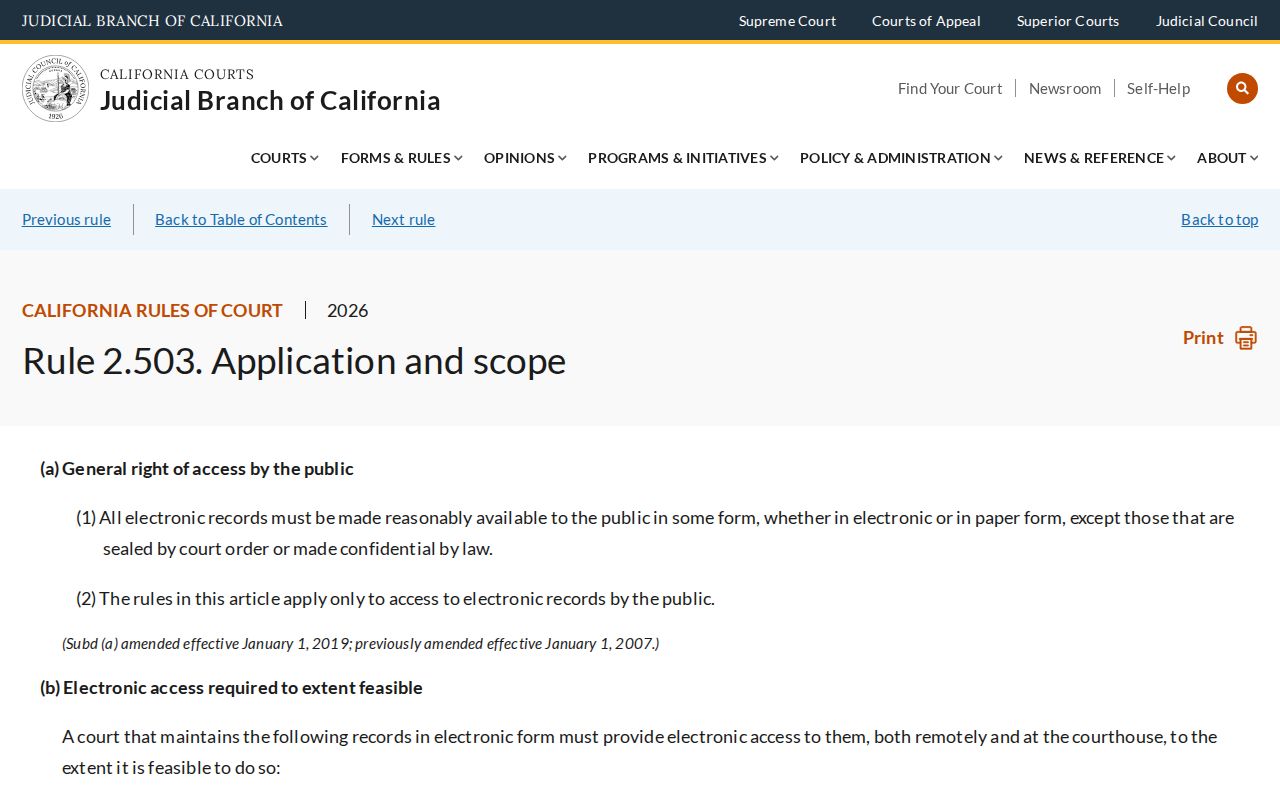
Rule 2.503 keeps remote access reasonable while limiting sensitive categories, so a terminal or clerk route may be needed for a lawful search.
Calabasas Probate and Adoption Records
Probate is useful when the person being traced is an heir, decedent, fiduciary or former owner. Public portions of a Los Angeles Superior Court probate file may show a decedent, petition, fiduciary and interested-person clues. Those filings can explain why a deed changed hands after death. They do not make every family detail public, and a name in a petition still needs a date, address or family tie before it can be matched.
For an heir trail, compare a probate event with a recorded deed, obituary and the legal description. For a former classmate or distant relative, a yearbook, alumni publication or library collection can supply a safer historical link. California adoption files are confidential. Use California's official adoption-information and reunion mechanisms when eligible; do not try to bypass a sealed or confidential file through a name compilation. A probate clue can guide a lawful request, but it cannot open an adoption record.
That distinction matters in Calabasas because land records, family records and court records sit with different custodians. A court clerk can route a filing or copy request, but should not be expected to resolve a namesake or release a restricted family record.
Calabasas Confidential Resident Records
Safe at Home gives eligible Californians a substitute mailing address, mail forwarding, confidential voter registration and service-of-process functions. The program serves victims of domestic violence, stalking, sexual assault, human trafficking, child abduction and elder or dependent-adult abuse, as well as specified reproductive-health affiliates and public workers and their household members. Enrollment runs through a designated enrolling agency.
The California Safe at Home program is a protection channel, not a way to discover a hidden address. It does not erase older records. Private or federal entities are not always required to accept the substitute address. A deed's legal description may still identify a parcel, even where Government Code section 6209.5 permits the designated address on certain deed and change-of-ownership forms.
California court copy guidance explains the distinction between a viewable record, an informational copy and a certified copy.
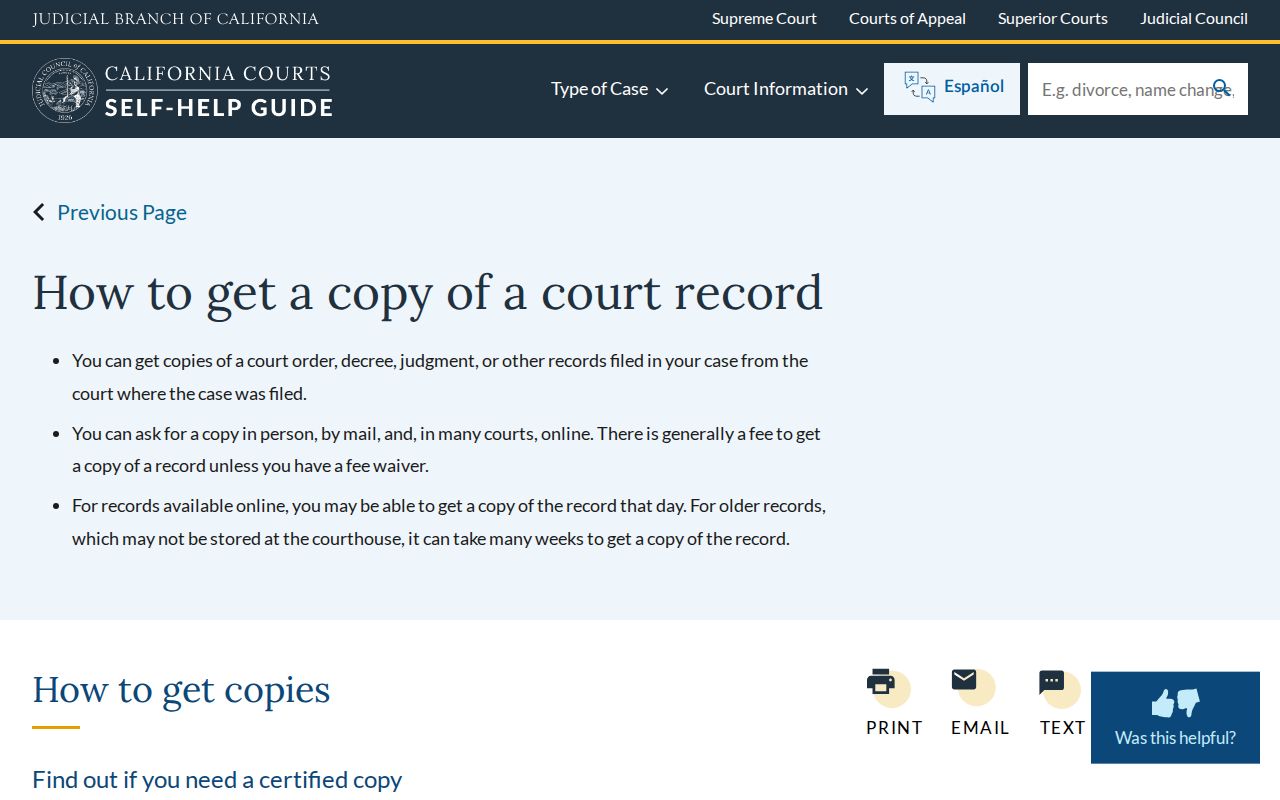
Copy guidance is another reminder that a document view, an informational copy and a certified copy carry different weight and different access rules.
California's Megan's Law Website publishes only registry information the law allows and includes use warnings. Juvenile, adoption, sealed and other confidential court records remain outside ordinary remote searches. Voter residence data, DMV data and full vital authorized copies have their own rules. If a protected person is missing from an index, absence is not evidence that the person left Calabasas.
The official California Megan's Law search should be read with its statutory-use notice.
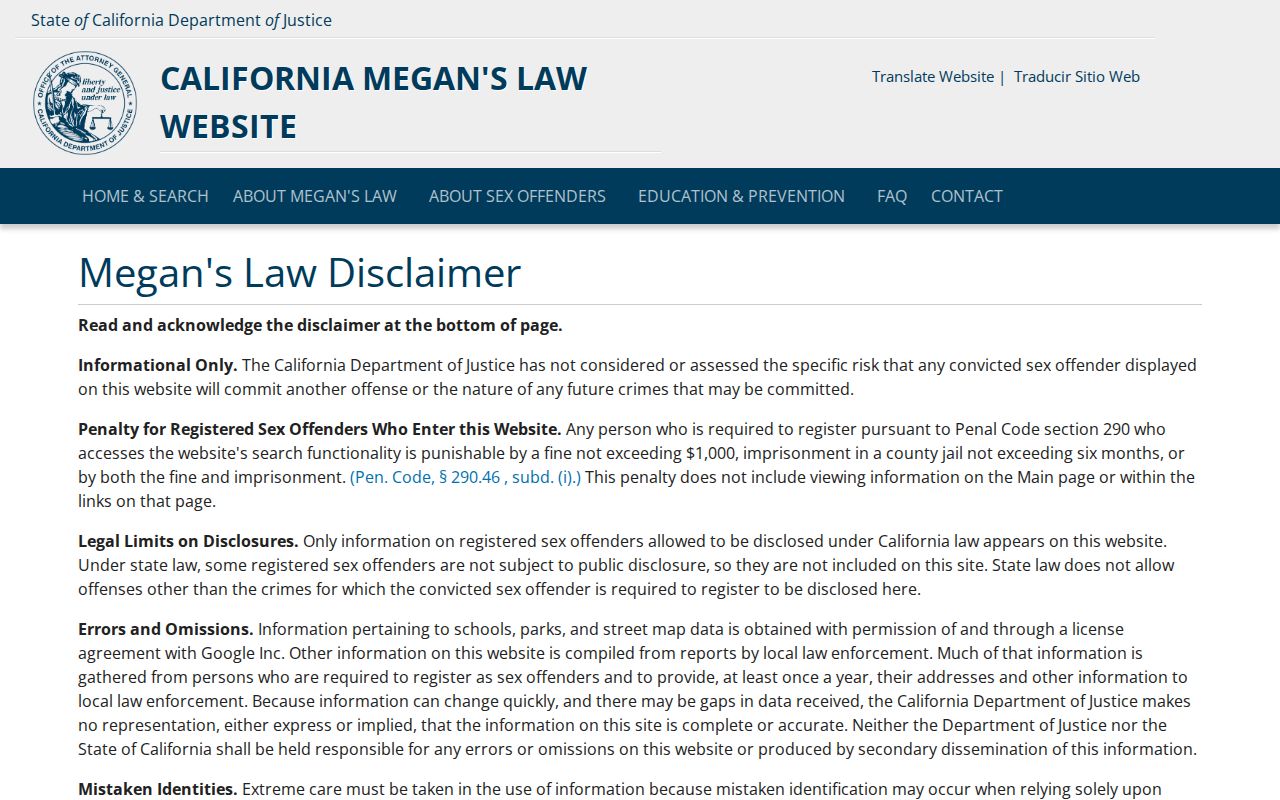
The registry is a defined public safety resource, not a substitute for a court, vital, voter or property record.
Calabasas Resident Lookup Limits
California's Public Records Act, Government Code sections 7920.000 and following, generally supports inspection of nonexempt state and local records. It does not override a vital-record eligibility rule, voter-purpose restriction, confidential court file or Safe at Home protection. Send a focused request to the agency that keeps the record. For a city file, describe an identifiable record, date span, department and preferred format through the Calabasas public-record request channel. The ordinary determination period is 10 calendar days, with a written extension of up to 14 more days in unusual circumstances.
Lawful use. A Calabasas resident lookup is for personal, lawful research, family history, reconnection and safety awareness. Using records to stalk, harass, intimidate or harm a person is not lawful and can trigger California civil or criminal remedies.
When an official record is wrong, contact the custodian that created it: the court for a docket error, the Assessor for assessment data, RR/CC Elections for voter information, and the commercial business for a compiled listing. Keep the search date, exact spelling, negative result and response. A clean record trail is more reliable than a single unexplained match.