
Sources for Calabasas Previous Residents
A one-address history needs a date range and a source that actually covers it. Los Angeles County real-estate records run from 1851-present, while directory, census, permit, and obituary coverage follows different calendars. The table places the deed chain beside the household sources so a title change is not mistaken for a move-in date.
| Source | Years It Covers | Where Held | What It Shows |
|---|---|---|---|
| RR/CC recorded deed index | 1851-present | Norwalk office index | Grantors, grantees, transfers, legal descriptions, and related instruments |
| RR/CC reading rooms | 1851-1957 lower level; 1958-present second floor | 12400 Imperial Highway, Norwalk | Free appointment viewing of the office-held real-estate index and records |
| Assessor parcel record | Current effective record | LA County Assessor Portal and lawful offline channels | AIN, situs, values, use, building facts; no online owner name |
| Regional city and reverse directories | 1873-1987 regional spans; exact Calabasas run not published | LAPL, Calabasas Library, and reference collections | Listed names, addresses, and historical household clues |
| Federal population census | 1790-1950 nationally | NARA and library databases | Household names, relationships, ages, and enumeration districts |
| Calabasas permits | Exact city-held start year not published | City permit channels, SmartGov, or public-record request | Project address, named parties, construction dates, and inspections |
There is no online address index for the county deed chain. Viewing is free by appointment, but copies use separate county channels and fees. For older household questions, start with a directory or census lead, then use title, permit, obituary, or probate records to corroborate it. For a current parcel question, start with the AIN and work backward.
Begin With the Current Calabasas AIN
The Assessor Identification Number is the anchor for a house history. Search the current situs address in the Los Angeles County Assessor Portal, save the AIN, legal or parcel description, map link, use type, assessment facts, and building characteristics, and record the portal’s effective-date information. The AIN is more stable than a postal line because a street name, number, community label, or mailing city can change while the parcel reference remains useful.
The online parcel card does not show the owner name. Do not fill that gap with a compiled profile or assume that the mailing address is the physical location. A situs address identifies where the parcel is; a mailing address identifies where correspondence is sent; neither one proves who lived there. If a parcel has been split, merged, or described by a tract and lot, compare the legal description before moving to an earlier deed.
For adjacent land, map selection can supply another AIN, but each parcel gets its own history. A neighborhood label such as Old Town, Calabasas Park, Mulwood, The Oaks, or Mont Calabasas is a useful orientation clue, not a substitute for the parcel key.
Get the Owner Through a Lawful Channel
The current owner or vesting information must come from a lawful Assessor channel because the county suppresses owner names on the public website. The research record identifies Assessor district counters and Property Data Sales as the available routes. The public portal remains valuable for the AIN and parcel facts, but it is not a failed name search. It is designed to separate free parcel research from the owner information channel.
Keep the owner result labeled as title evidence. A person named on an assessment or deed may receive tax mail at a different address, may hold title for an estate or entity, or may not be the documented occupant. The same caution applies to a permit owner, project contact, or entity agent. A house history becomes more reliable when it states “recorded owner,” “tax-mail recipient,” “permit contact,” or “listed householder” rather than using the broad word resident for every name.
That distinction is also the safety boundary for previous residents research. The purpose is to reconstruct a property’s documented past, connect family evidence, or understand a parcel’s history. It is not a reason to expose a current person whose address is protected or to combine unrelated records into a profile.
Walk the Calabasas Deed Chain Backward
Los Angeles County RR/CC holds real-estate records from 1851-present. The index is alphabetical by grantor, grantee, and recording year, not by address. Start with the current owner obtained through the lawful Assessor channel, then work backward from each recorded transfer. The same legal description, tract, lot, and parcel references matter more than a modern street string when the address has changed.
- Search the current owner as a grantee in the likely acquisition year and capture the instrument number, date, grantor, and legal description.
- Search the seller as a grantee to locate the seller’s earlier purchase, then repeat the same comparison.
- Mark deeds, deeds of trust, reconveyances, liens, releases, plats, and other instruments by type before calling one an ownership change.
- When a common name appears, follow the exact document reference and land description instead of accepting every same-name hit.
- Stop at a genuine gap and document it. The county has no public online index to bridge by typing the address.
The RR/CC real-estate-records access page describes the office-held index and reading-room arrangement. The recorder image belongs at the point where a current parcel becomes a backward title trail.
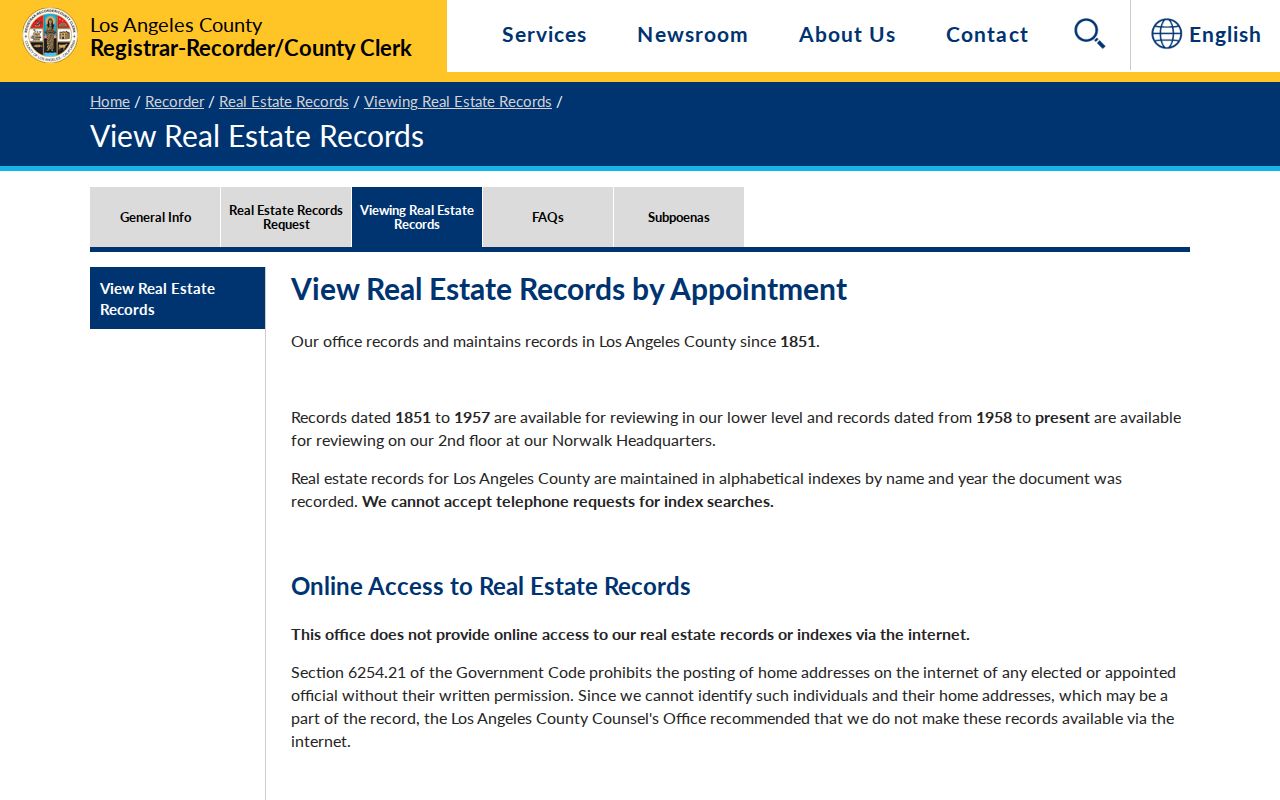
A deed image can show indexed party names and roles, document type, recording date, instrument number, legal description, return address, vesting language, signatures, and notary information. It shows a recorded transaction. It does not prove that a grantee occupied the property.
Legal Descriptions Keep Calabasas Address History Straight
One modern address can sit on land that earlier documents describe by lot, tract, map, or a different street label. Before connecting two previous residents, compare the land reference and the transfer type. These definitions keep the chain of title separate from the household trail.
- Grantor
- The party transferring an interest in a recorded instrument, often the seller or prior title holder.
- Grantee
- The party receiving an interest, often the buyer or new title holder. A grantee is not automatically an occupant.
- Chain of title
- The ordered sequence of recorded transfers and related instruments used to follow title backward through earlier parties.
- Legal description
- The recorded land description, such as a tract, lot, map, or parcel reference. It can be more dependable than a changing street address.
Subdivision, parcel split, lot merger, or a proximity notation can make a current situs correspond to earlier land described differently. Do not copy a recent postal address backward unchanged. A trust deed, reconveyance, or lien may appear between two deeds without changing the owner. Mark each instrument before using it to date the prior owner.
Norwalk Reading Rooms Divide the Chain
The RR/CC arrangement preserves an important time split. Records from 1851-1957 are reviewed on the lower level at Norwalk, while 1958-present material is on the second floor. Viewing is free by appointment. The office is at 12400 Imperial Highway, Real Estate Records Room 2207. The county lists weekday hours of 8 a.m. to 5 p.m., (800) 201-8999 option 3, and recorder@rrcc.lacounty.gov.
Copies can be ordered online through the county’s LexisNexis contractor, by mail, fax, or in person. The county says online orders may take up to 20 working days and that the complete recorded document must be purchased. A certified recorded copy is $6 for the first page plus $3 for each additional page. The recorded-document request page gives the county's copy-order route. Recording charges are separate. Confirm the current fee schedule and request path before sending payment.
The RR/CC fee page shows the published access and copy-fee context. The fee image is useful because an official record request and a private solicitation are not the same thing.
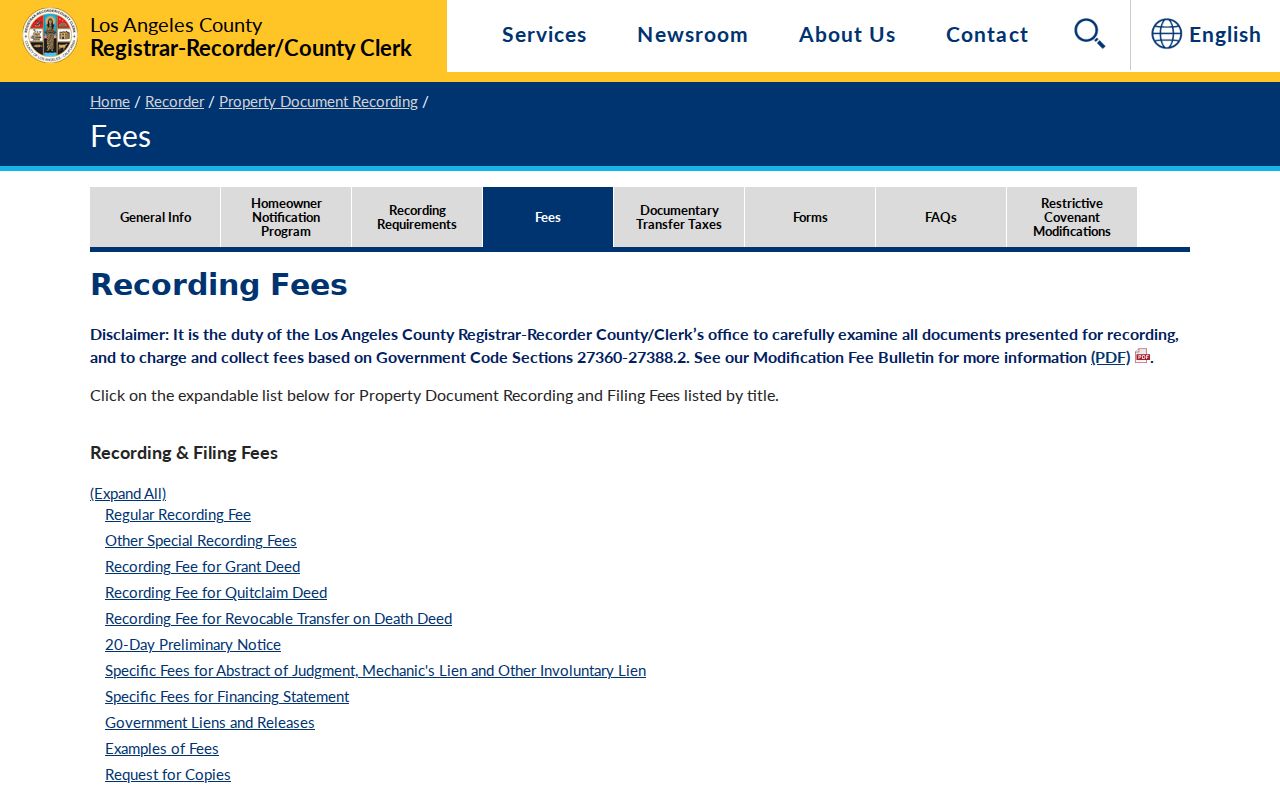
Read the free index first when possible, then order only the complete instrument needed to confirm a transfer, legal description, or family connection. Keep the office date and request number with the copy.
Calabasas Permits Date a Structure
Permits can tell when a project was proposed, issued, inspected, or completed at an address. Calabasas permit records may identify the project address, permit or application number, valuation, petitioner, property owner, architect, contractor, engineer, contact details, description, issuance date, and inspection dates. The physical permit card can show inspection date and pass, correction, or fail status. Those facts date construction and alteration. They do not establish who slept at the address.
The public SmartGov portal provides account tools for applications, projects, document uploads, connected permits, fees, payments, and inspection requests when the person is listed on the issued permit. The public crawler did not expose a complete issued-permit lookup without an account. Building and Safety states that permit records are public, while stamped plans and off-site files may require a city public-record request. Approved residential plans are retained for 90 days after final inspection under Health and Safety Code §19850, and copying sealed plans requires owner and design-professional authorization.
Use the city’s Public Records Request form for an identifiable permit file, date span, department, and preferred format. The city’s Building and Safety contact is (818) 224-2534 and BuildingSafetyInfo@cityofcalabasas.com. A permit contact may be an agent or may be stale, so compare it with the deed and household sources.
The SmartGov public portal image shows the city’s project and permit entry point. It is a construction chronology clue, not a current household directory.
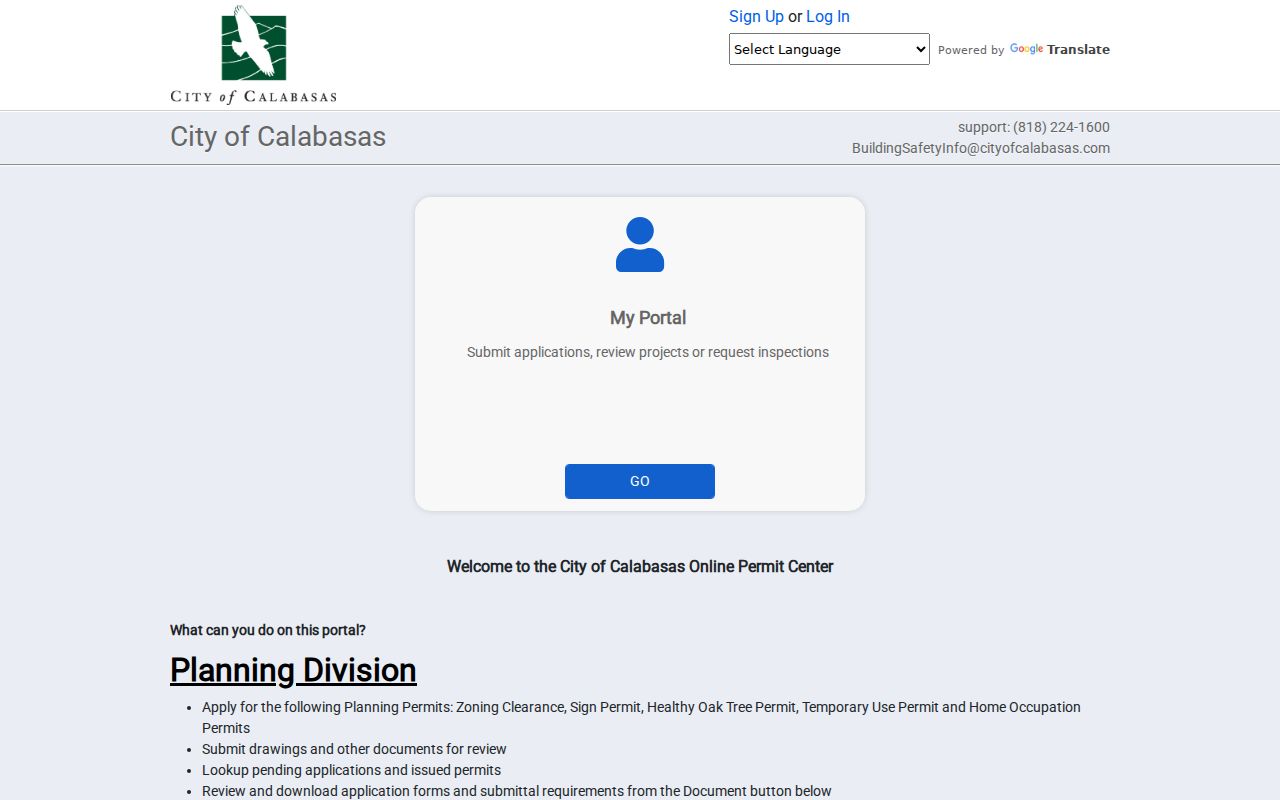
When a house has no directory hit, a permit can still establish when a structure or alteration was present. When a permit names a person, use the name as a lead to test elsewhere rather than as occupancy proof.
Separate Title From Previous Residents
Owners are only one part of a house history. A household may include people who never appear in a deed, while a deed may name an estate, trust, entity, or person who lived elsewhere. The county Assessor’s mailing address can differ from situs. A permit can carry an owner, agent, contractor, or architect. A directory can carry a listed householder or phone subscriber. Put every result in its own evidence column.
For a past household, look for a regional reverse directory, a name-first city directory, an open census schedule, a newspaper notice, an obituary, or a probate record. Use dates and family links to separate namesakes. An obituary can connect a person to a former place; probate can explain a transfer after death; a census can show household relationships at enumeration. None should be stretched beyond the fact it records.
HOA, block-watch, congregation, club, utility, and DMV sources do not create a public resident roster. The city’s 2024 HOA document is a contact list for associations and property managers, not a list of members. A missing name may reflect privacy, a non-indexed household member, a protected address, or a collection gap.
Pair Directories With Calabasas Households
The regional city-directory shelf can supply a name and address clue, but exact Calabasas-named Polk or criss-cross runs and a verified local sample have not been published. The Los Angeles Public Library collection includes historic city and business directories from 1873-1970 and street-reverse volumes for 1906, 1927, and 1956-1987, sometimes with county coverage. Ask a reference librarian to verify whether the address appears in a particular volume.
Pair a directory year with the closest open census year. Capture the printed street spelling, house number, initials, spouse notation, telephone mark, and page. Search the census by name and address clue, then compare ages, relationships, and enumeration district. Follow the household across neighboring editions and note “removed to,” widow, or unlisted marks. For a complete collection description, use the Calabasas city directory shelf rather than treating one reverse hit as a deed record.
- Preserve the directory citation and its abbreviation key.
- Check the nearest open census schedule and compare household details.
- Test the same person in the next directory year and in an obituary or newspaper index.
- Use a deed, permit, probate, or family record to confirm that the address and person connect.
Previous residents research works best as a paired flow: directory clue to census household, then independent record to address continuity. A blank edition is a gap, not a disappearance.
Close Previous Residents Trail With Probate
Probate can close a house-history trail when an owner or occupant died, left an estate, or transferred property through a fiduciary. Los Angeles Superior Court public portions may identify a decedent, fiduciary, interested person, petition, order, or disposition. Use the case record to understand a transfer, not to assume that every person named was a resident. Obituaries and cemetery records can add family links, while adoption files and other confidential records stay within their authorized channels.
The RR/CC’s January 21, 2025 wildfire record-recovery guidance gives unusually concrete intake facts. A real-property request needs grantor or grantee names and an approximate recording date; the recorder cannot search the request by address. A vital-record request needs the event, person, relationship, and a notarized affidavit. Those facts are useful for a damaged-record recovery request and also show why an address alone is not enough.
Los Angeles County is also reviewing recorded documents from 1850 forward for unlawful restrictive-covenant language, then preserving the chain through re-recording. That work is both a current records initiative and a historical house-history lead. It does not rewrite a deed chain or identify a past household by itself.
The RR/CC restrictive-covenant modification program describes the county review. The image connects a present-day records project to older recorded instruments while leaving the original evidence and legal context to the custodian.
Lawful house history. Previous residents research in Calabasas is appropriate for family history, estate work, property history, and personal curiosity. Do not use a past address trail to stalk, harass, intimidate, or expose protected information about a living person.
Keep a final timeline with separate columns for title holder, tax-mail recipient, permit party, listed householder, census household, and documented occupant. That format preserves the value of the records without claiming more than the evidence supports.