
Calabasas City Directories Start Regionally
The most defensible Calabasas directory trail begins with the regional shelf, not a claimed stand-alone municipal run. Calabasas incorporated in 1991, so earlier entries may use Los Angeles County, a ranch or subdivision name, an adjacent community, or a telephone exchange. The table separates confirmed regional collections from holdings that still require a librarian’s answer.
| Collection | Years | Where Held | Access |
|---|---|---|---|
| Federal population census | 1790-1950 nationally | National Archives and genealogy collections | Free 1950 search; earlier schedules vary by collection |
| Historic City and Business & Phone Directories | 1873-1970 | Los Angeles Public Library digital collection | Keyword search or Browse Titles |
| Los Angeles Street-Reverse Directories | 1906, 1927, 1956-1987 | Los Angeles Public Library digital and reference collections | Street-order volumes; county coverage must be checked |
| Regional telephone and directory volumes | Exact Calabasas span not published | Los Angeles Public Library and Calabasas Library | Reference inquiry |
| Reverse or criss-cross directories | Exact Calabasas run not published | Los Angeles Public Library History & Genealogy | Ask staff for title, year, and address coverage |
| LA County Library Californiana | 19th-century directories; census 1850-1910 | Norwalk closed-stack collection | Reference-only research access |
No official source located an exact Calabasas-named Polk or criss-cross run, and no verified local sample entry was found. That gap is part of the result. It means a researcher should not turn a regional Los Angeles title into proof that a particular Calabasas household appears in it without checking the scan, call number, publisher, and page.
Calabasas Library Catalog First
The Calabasas Library catalog is the local starting point for titles, yearbooks, local histories, and possible directory leads. Search title, author, subject, and keyword, then filter by material type, publication date, and branch. A catalog hit identifies a holding or record, but it does not by itself establish that the volume contains a Calabasas address. Ask the reference desk to confirm the shelf location, publisher, edition, and whether a reverse section is present.
Official library web pages did not publish an exact Calabasas city-directory or reverse-directory year run. The useful request is specific: ask for every Calabasas-named directory, Los Angeles County telephone directory, address directory, yearbook, and local-history volume that could place a household at an address. Ask whether a licensed database can be used in the building and whether staff can inspect a printed volume when an online catalog record is broad.
The Calabasas Library catalog shows the local catalog search environment. It is a better first stop than assuming a general web search has found every regional holding.
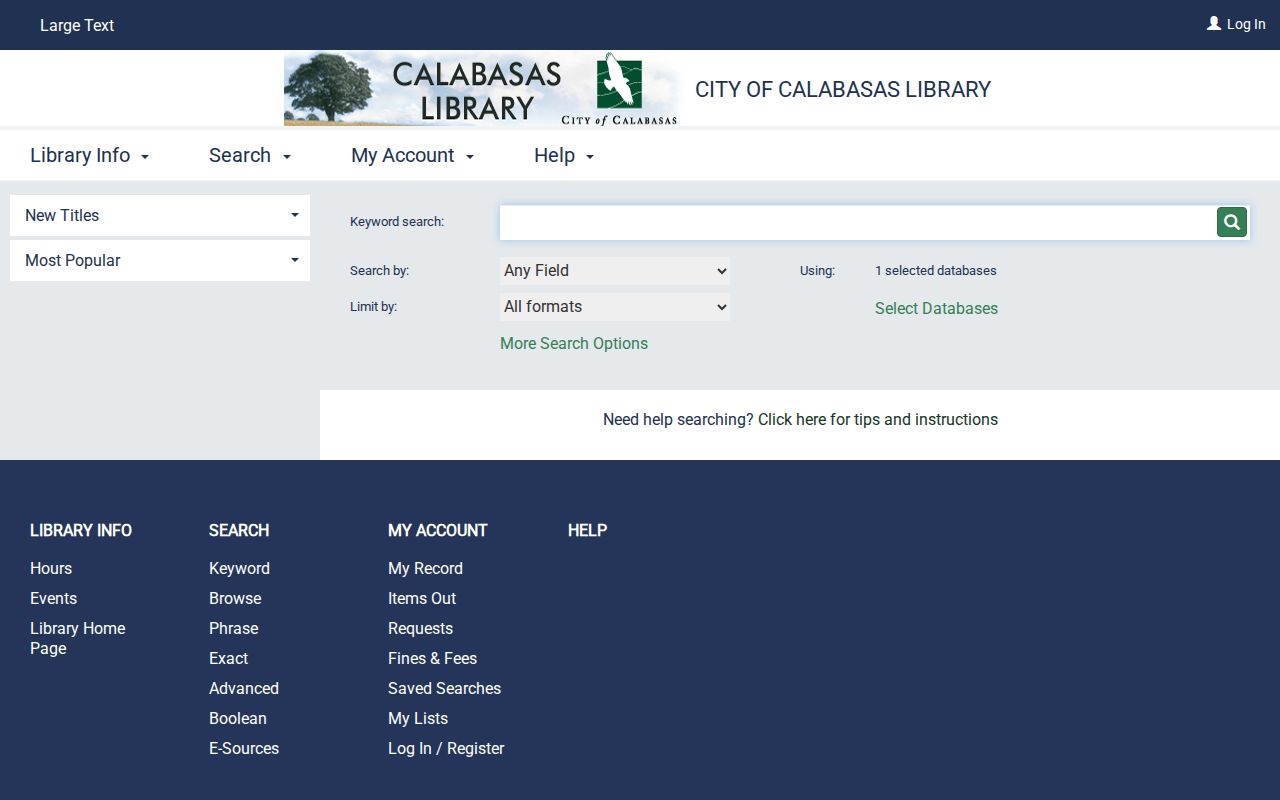
Use the catalog image as a prompt to record the search terms and filters used. A negative catalog result should lead to a reference question, not to an invented publication gap.
Los Angeles Regional Directory Shelves
Los Angeles Public Library is the strongest regional fallback. Its History & Genealogy collection reports roughly 52,000 genealogy titles, more than 5,000 microfilm rolls of United States directory volumes from 1861-1960, earlier microfiche, about 1,000 hard-copy directories, and Los Angeles directories from 1873-1942 in paper or film. The collection is reference-only. Those holdings can place Calabasas research inside the larger Los Angeles record geography even when a title does not use the city name.
LA County Library’s closed-stack Californiana collection at 12350 Imperial Highway in Norwalk adds more than 24,000 books and 200 newspaper or magazine titles. Its described holdings include California census schedules from 1850-1910, Alta California from 1849-1891, the Los Angeles Star from 1851-1879, nineteenth-century directories, and official city and county histories. Additional genealogy catalog entries can identify county marriages, homesteads, mortgages, patents, and other record sets, but image access varies by contract.
Early verified regional titles include the Los Angeles City Directory for 1873, 1875, 1878, 1879-80, and 1881-82; the Los Angeles Telephone Directory from 1882; the Los Angeles and Santa Ana Valley City Directory from 1883-84; the Atwood Los Angeles City Directory from 1883-84; and the Coast County Directory including Los Angeles County from 1884-85. These examples prove regional publication, not annual completeness or inclusion of every Calabasas household.
The LA County Library local-history collection explains the regional reference shelf. Its presence is especially useful when a Calabasas clue is older than the city’s incorporation or appears under a county community label.
Regional custody changes the search question from “Where is the Calabasas book?” to “Which Los Angeles volume could have reached this community, and how can the keeper confirm it?”
Digitized Los Angeles Directory Volumes
The Los Angeles Public Library digitized collection states a 1875-1987 span and separates two useful groups. Historic City and Business & Phone Directories run from 1873-1970, are arranged alphabetically by person or business, and sometimes include county residents. Los Angeles Street-Reverse Directories include 1906, 1927, and 1956-1987 volumes, normally arranged by street and sometimes reaching county cities. The browse inventory contains 184 items. A keyword search can run across years, while Browse Titles opens one scanned volume.
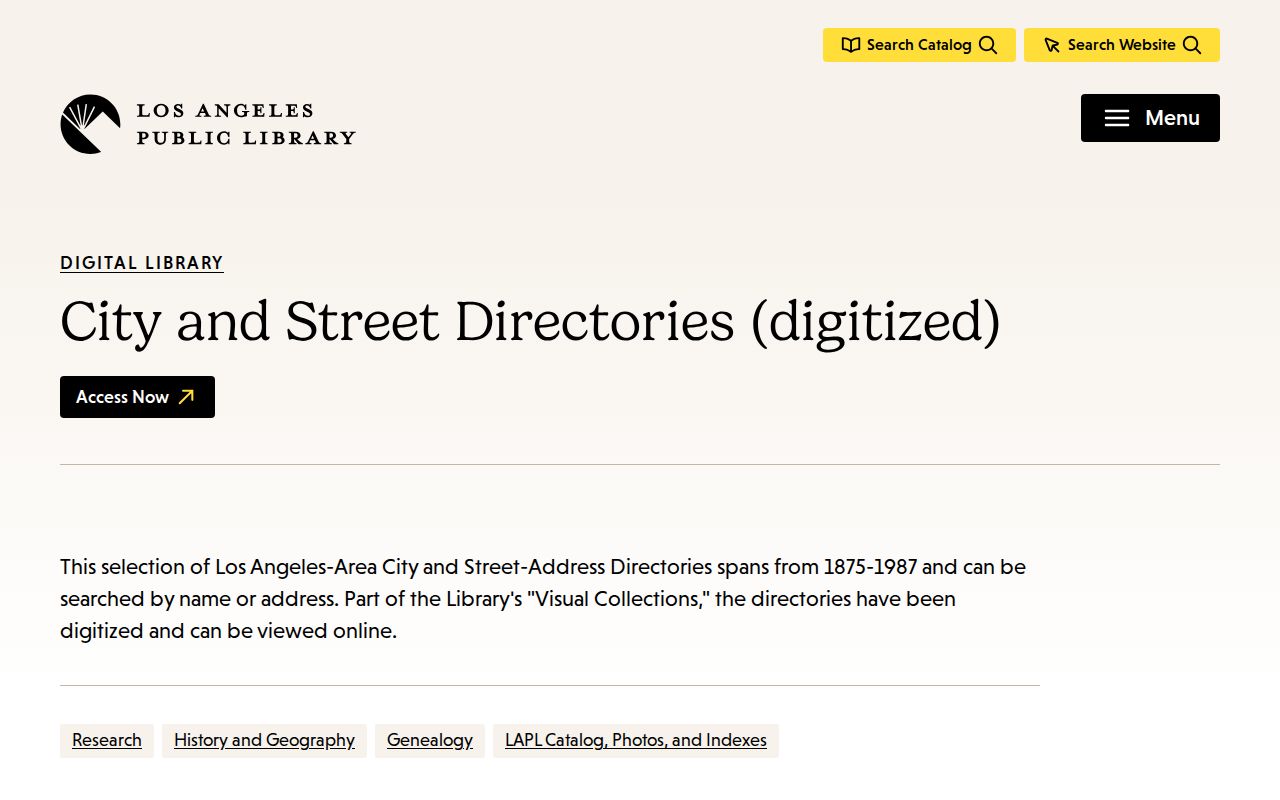
The LAPL City and Street Directories digitized collection is the clearest open online route for testing a regional volume. The collection image points to a shelf that can be searched, but a hit still needs an address and jurisdiction check.
The Historic directory browser provides another view into the same research problem. Use the historic directory collection browser to inspect city, business, telephone, and reverse-directory groupings.
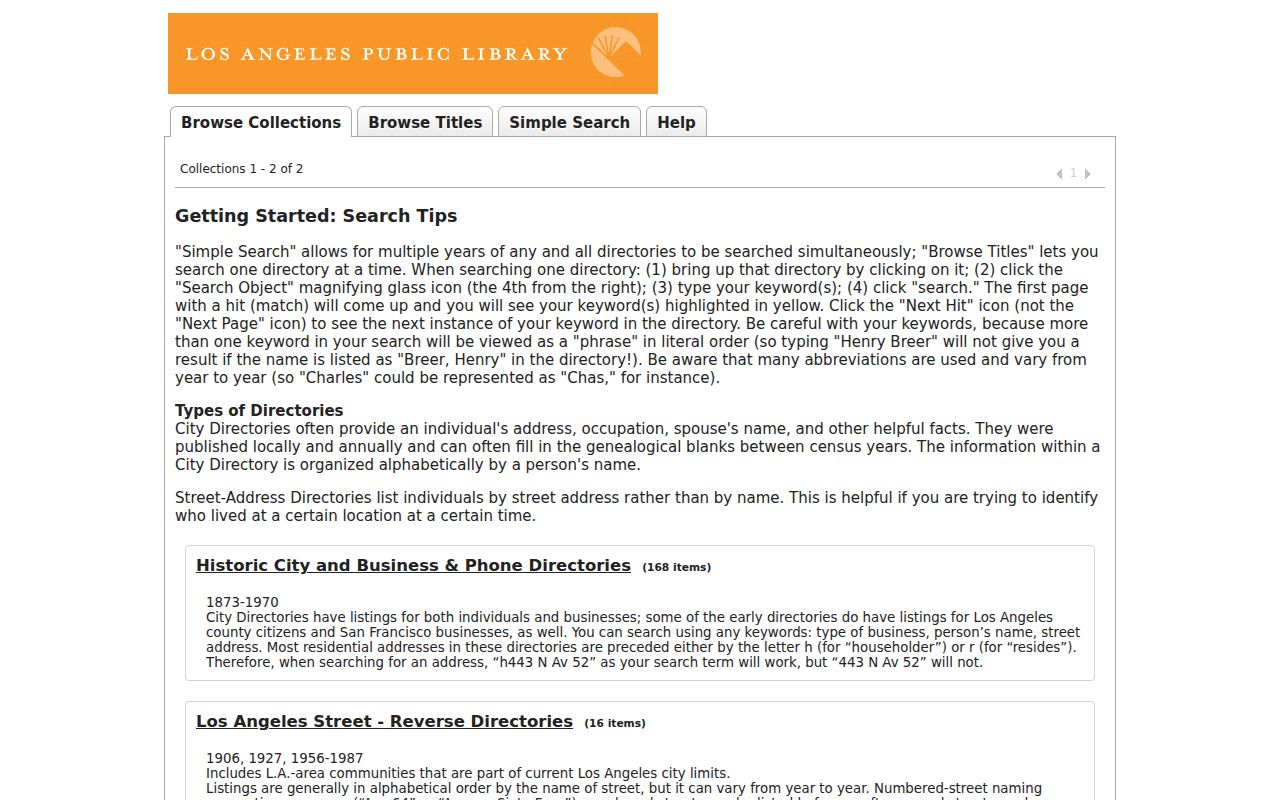
OCR and address forms matter. LAPL’s example searches for h443 N Av 52, not simply 443 N Av 52; h marks householder or home and r marks residence. Try Avenue, Ave, and Av, along with numbered-street variants. A 1929 scan titled Los Angeles Directory Co’s Los Angeles City Directory 1929 includes private citizens, a street and avenue guide, a buyers’ guide, and classified business material, but no Calabasas-named person or address entry was verified in the scan.
Reading a Calabasas City Directory Entry
A printed entry is a compressed snapshot. Read the key before interpreting initials, punctuation, or a cross-reference. The same person may appear in an alphabetical name section, a street section, and a telephone listing, with small differences in spelling. The sample inventory below describes fields documented in the regional twentieth-century format. It is a reading key, not a verified Calabasas page.
| Printed name | Surname, given name, and an initial or spelling variant. |
|---|---|
| Household note | A spouse in parentheses, widow notation, or a cross-reference to another name. |
| Address | House number and street, sometimes with a residence, home, or boarding mark. |
| Telephone | A number when the household or business was listed and subscribed. |
| Occupation line | A historical work or business clue that can help separate namesakes. |
| Owner or renter mark | A publisher-specific symbol or abbreviation when that edition used one. |
Record the page number, title, publisher, edition year, and printed address exactly. A directory can list a business at a home address, a household head, a boarder, or a person who had already moved when the volume went to press. Match the result to a census, obituary, permit, or deed before treating it as a family connection.
Criss-Cross Searches by Address
Reverse or criss-cross pages invert the usual name-first order. They are helpful when the address is known but the household name is not. In a regional volume, the street section may follow street names and house numbers, then point back to the alphabetical entry. That can reveal a listed householder or phone subscriber, but absence can mean an unlisted number, a move before publication, a boundary choice, or an OCR miss.
- Criss-cross directory
- An address-ordered directory that can move from a street and number to a listed person or phone entry.
- Householder index
- A name or address aid that identifies the person treated as the head of a listed household, not every member.
- Abbreviation key
- The publisher’s guide to marks such as home, residence, boarding, widow, or cross-reference. Photograph or transcribe it first.
- Reverse hit
- A historical listing connected to an address. It is evidence of a directory entry, not proof of ownership or current occupancy.
No official source has verified an exact Calabasas-named Polk or criss-cross run or a local sample entry. Ask LAPL History & Genealogy or the Calabasas Library to identify the title and years before relying on a reverse search. The uncertainty is important because regional directories may cover county residents unevenly.
Pair Directory Years With the 1950 Census
The federal census supplies a household check that a printed volume lacks. The 1950 census is currently the newest open population schedule under the federal 72-year rule. It can show names, relationships, ages, occupations, and an enumeration district, subject to address matching. The 1960 census is scheduled for release in 2032. Pairing a directory with the nearest available census avoids treating one printed line as a complete household.
- Capture the directory title, edition year, printed street form, page, name, and every abbreviation.
- Search the matching census year or the closest open schedule using surname, given name, address clues, and enumeration district.
- Compare household relationships, ages, and spelling rather than expecting a directory and census to use identical names.
- Follow the address forward and backward in neighboring directory editions, noting moves, widow marks, and “removed to” clues.
- Close a disputed identity with an obituary, probate file, deed, permit, cemetery record, or family collection.
The National Archives 1950 census search provides the free federal entry point. Its image belongs beside the directory workflow because the two collections answer different questions: the directory shows a published listing, while the census records an enumerated household at a particular time.
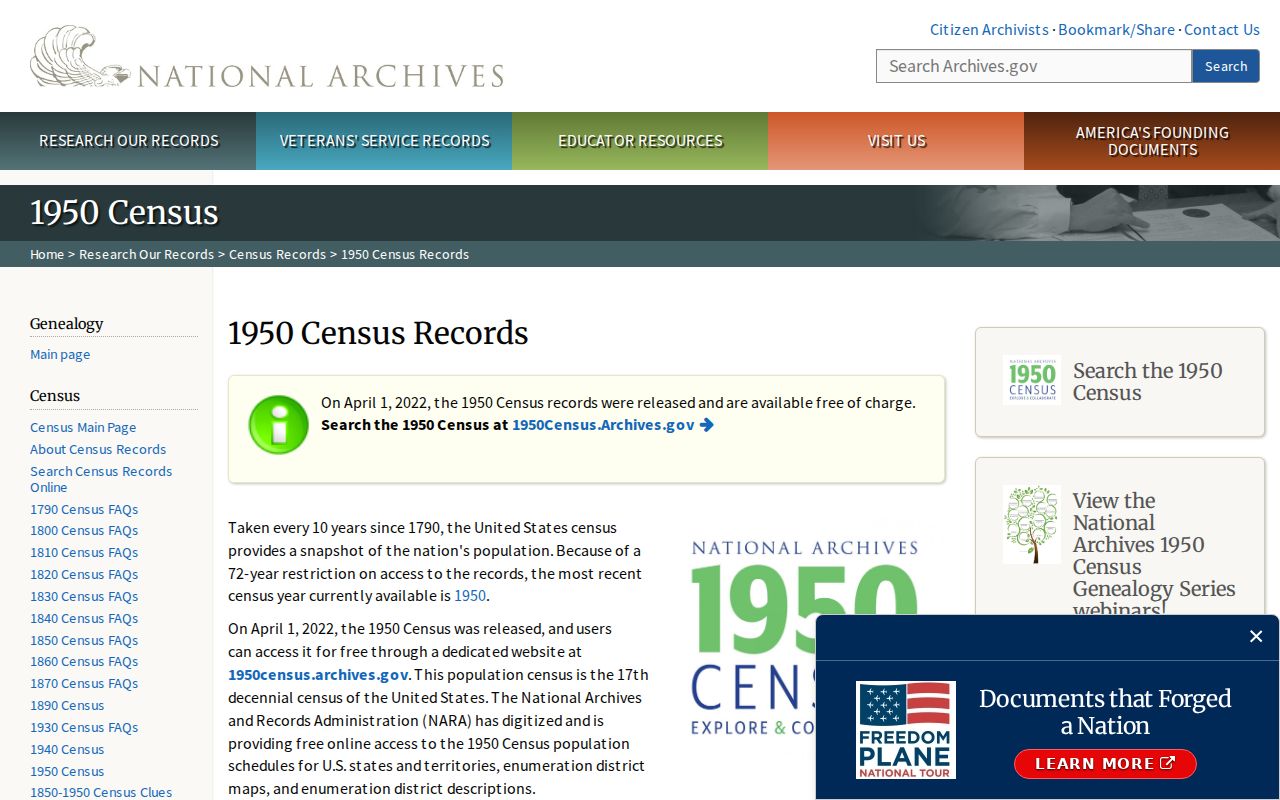
A census match still needs a location test. Calabasas may be described through a county or community label, and enumeration districts do not always follow today’s city boundary.
Missing Volumes Do Not Prove Absence
A blank year in the Calabasas directory trail does not establish that a family was absent. Regional publication boundaries, unlisted telephones, late moves, name abbreviations, business-only coverage, and changing community labels all create gaps. A publisher may have included an address in a county volume without using “Calabasas” in the title or index. Conversely, a Calabasas-named title could omit a particular canyon or subdivision.
Test the gap with several forms of the same clue. Search surname and initials, street spelling variants, nearby communities, telephone exchange language, and the printed address prefix. Compare a directory year with census records, newspapers, maps, permits, obituaries, and probate. If an address changed, a tract map or LAPL’s street-name research may be more useful than repeating the same name search.
The regional record history also explains why older entries may look unlike a present volume. Calabasas incorporated in 1991, while the land and household trail is older. The strongest conclusion may be “the regional collection has not yet been checked for this address,” not “no one lived there.”
Verify Local Holdings With a Librarian
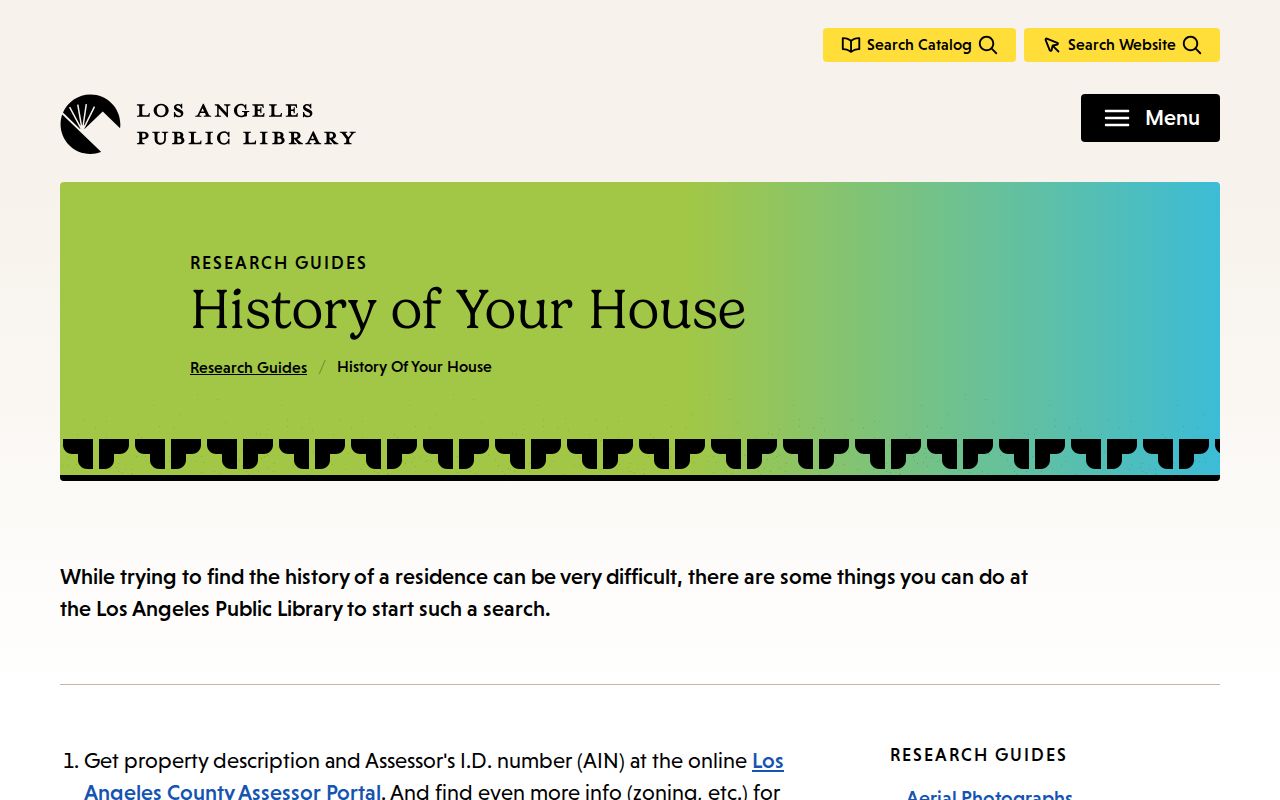
Reference staff can answer questions that a catalog record cannot: whether a volume includes county cities, whether the scan is complete, whether a street section survives, and whether a call number leads to microfilm, paper, or a licensed database. LAPL’s house-history method uses directory occupants from 1873-1942, California voter registrations from 1900-1968, HeritageQuest, TESSA photographs, and Street Names of Los Angeles for renamed streets. These are research paths, not proof that a Calabasas-specific run exists.
The LAPL history-of-your-house guide shows how directories, voter registrations, maps, and permits can be combined. It is especially useful when a house history needs an address bridge rather than a person-first search.
For a county-level question, the LA County Library local-history page points toward closed-stack Californiana holdings and reference assistance. Ask for an exact title, publisher, years, coverage note, and access condition. Preserve the librarian’s answer with the search log so a future family-history researcher can tell a verified holding from an untested lead.
Regional Milestones for Calabasas Research
A short timeline keeps the historical directory search grounded without pretending that a Calabasas run is complete.
- 1873-1885: Verified Los Angeles city, telephone, valley, and county directory titles establish the regional shelf.
- 1906: A verified Los Angeles street and avenue guide and a street-reverse volume provide an address-order model.
- 1927: Another verified street-reverse year offers a regional address comparison point.
- 1929: A scanned Los Angeles volume shows private-citizen entries, a street guide, and publisher search tools, but no verified Calabasas-named entry.
- 1956-1987: LAPL’s verified street-reverse span supplies later regional address volumes, with exact Calabasas inclusion still requiring a title check.
- 1991: Calabasas incorporation marks the point after which city-created records become a distinct municipal layer, while county and regional records remain essential for earlier history.
For one address backward through title and occupancy clues, pair these regional collections with the Calabasas previous-residents workflow. The historical directory shelf remains useful for names and addresses, careful about gaps, and strongest when paired with a record that answers a different question.