
How Calabasas Residents Are Found
A name search and an address search lead to different custodians. A known address first belongs in the Los Angeles County Assessor Portal, where the street address or Assessor Identification Number, called an AIN, produces parcel facts. The public web card does not show the owner name. A known person can be checked through the Los Angeles Superior Court case gateway, state license and business indexes, and the voter self-verification tool when the person has the required private details. Historic questions need a library or archive rather than a current parcel card.
Keep the question narrow. “Who owns this parcel?” is a title and assessment question. “Who was listed here in 1950?” is a directory or census question. “Did this person file a case?” is a court question. A result can be useful without proving residence, and a blank result can reflect a closed record, an unlisted household, a changed address, or a gap in digitization.
- Write down the full name or normalize the address, including street suffix and unit information.
- Use the county Assessor Portal for an address or AIN, then save the parcel and legal-description details.
- Use the matching custodian: court case search for a case, elections services for a permitted voter-record request, or vital-record forms for an event.
- Use a city permit file, obituary, census page, or regional directory to test whether an owner or party was also an occupant.
- Record the date and source for each result, and ask the holding office when the record is not online.
For a street-by-street chain, the dedicated Calabasas street directory keeps the AIN, parcel, deed, and occupant layers in their proper order. The home workflow only sets the starting point.
The Offices Behind Calabasas Resident Records
Calabasas is an incorporated city, but it is not a separate county records jurisdiction. The city clerk holds city-created files. Los Angeles County Registrar-Recorder/County Clerk, or RR/CC, holds deeds, vital certificates, elections material, and county-clerk filings. The county assessor supplies parcel facts, while the Superior Court handles countywide civil, criminal, family, probate, and small-claims cases.
Each office answers a different part of a resident question. A permit can place a named owner, contractor, or project contact at an address during a construction event. A deed places parties in a recorded transfer. An election record can confirm a subject's registration when the request meets the law. None of those sources alone is a complete household list.
Los Angeles County RR/CC
Real Estate Records Room 2207
12400 Imperial Highway
Norwalk, CA 90650
(800) 201-8999 option 3
Los Angeles County Assessor
Address and AIN search online
Owner names are available through district counters or Property Data Sales.
Los Angeles County Elections
Election Information Section
12400 Imperial Hwy., Room 2013
Norwalk, CA 90650
(800) 815-2666 options 2 or 4
Calabasas City Clerk
City Hall
100 Civic Center Way
Calabasas, CA 91302
(818) 224-1600
For a city-created file, use the Calabasas public-record request form with an identifiable record, date span, department, and preferred format. A request asks the custodian to locate a record. It does not ask an office to investigate a person.
Address to AIN: Calabasas's First Move
The Assessor Portal is the cleanest first move when the clue is an address. Enter the situs address or AIN in Basic Search, switch to Legal Search when the parcel description matters, or use Map Search to select a parcel. The returned card may show use type, legal or parcel description, assessed land and improvement values, tax-rate area, building characteristics, and map links. It intentionally omits the owner name from the public website.
That omission changes the workflow. Do not infer an owner from a parcel card, a tax-mail clue, or a same-name search. The county says owner information is available at Assessor district offices or through Property Data Sales. Once a lawful owner-name source is obtained, that name and an approximate year can be taken to the RR/CC grantor and grantee index.
| Portal control | Type | What it does |
|---|---|---|
| Search by AIN or Address | Autocomplete or text | Accepts a parcel key or situs address |
| Basic Search | Tab or button | Primary address and AIN mode |
| Legal Search | Tab or button | Legal and parcel-oriented search |
| Map Search | Tab or button | Pan, zoom, and select parcel polygons |
The Assessor mapping help explains the portal's search behavior and owner-name suppression. A parcel is land identified by a legal description and AIN. The situs is the physical location. A mailing address is for correspondence. Those labels must stay distinct.
The captured Assessor Portal view shows the address and AIN search path used for a Calabasas residents directory inquiry.
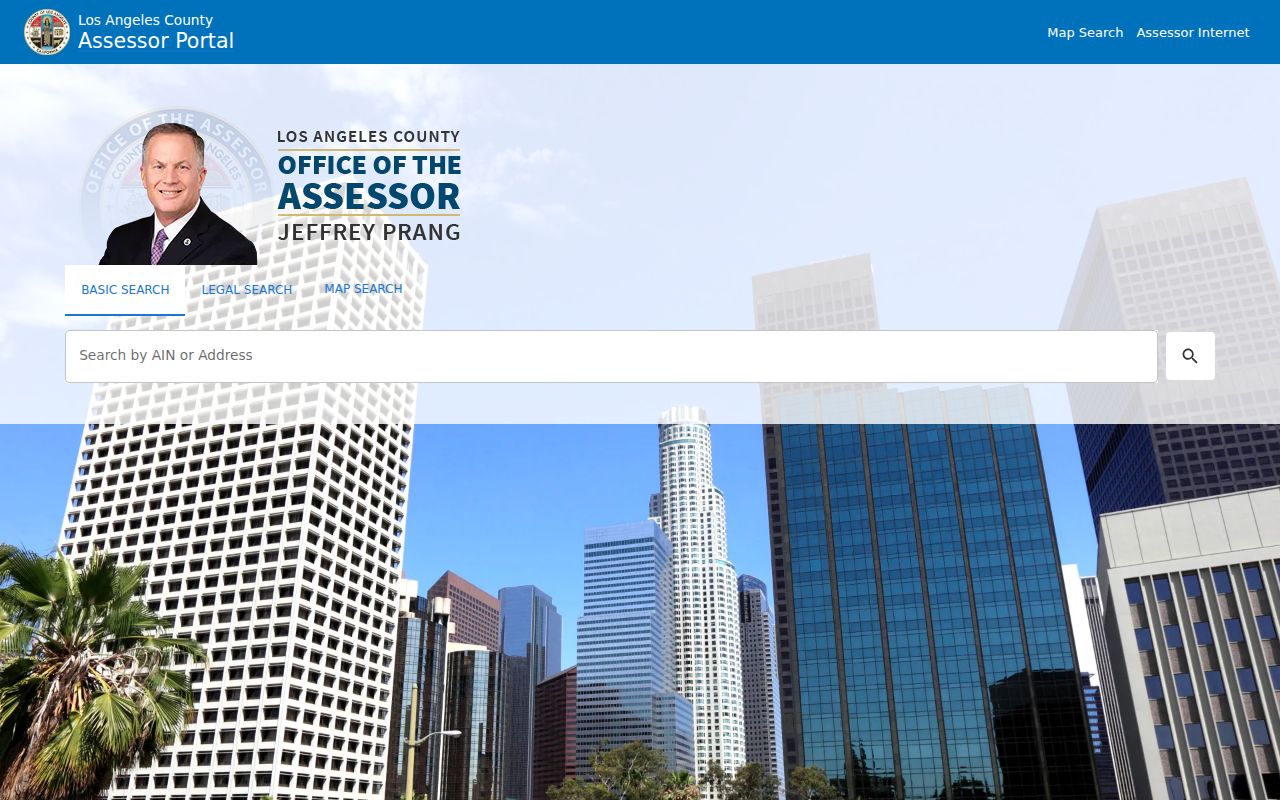
The parcel image is a starting map, not a resident roster. It helps connect a street clue to a stable county key before a name-based deed search.
The Online Owner-Name Gap in Calabasas
Calabasas searchers often expect the county parcel page to return an owner name. Los Angeles County deliberately withholds owner names from the public website under its reading of former Government Code §6254.21. The result is a useful quirk: the web gives a parcel, but the next identity step is offline or a paid data channel.
This is not a dead end. Use the district counter or Property Data Sales, then verify the resulting name against the recorded instrument. Keep title evidence separate from occupancy evidence. A grantee may be a trust, estate, or entity. A mailing address may be outside Calabasas. A permit applicant may be an agent. A directory or census entry is what can add household context.
Practical distinction. An AIN can identify the parcel without identifying the household. Treat the owner channel, situs, mailing address, and occupant source as four separate facts.
Following Calabasas Deeds at Norwalk
The RR/CC recorder holds Los Angeles County real-estate records from 1851. The index is arranged alphabetically by grantor, the person transferring an interest, and grantee, the person receiving it, with a recording year. There is no public Internet deed index and no address search. Viewing is free by appointment. The Norwalk office reads 1851 through 1957 material on the lower level and 1958 to present on the second floor.
Search the current owner as grantee in the likely acquisition year. Capture the grantor, recording date, document number, legal description, and instrument type. Then search that grantor as a grantee in an earlier period. Deeds and deeds of trust are not interchangeable, and a reconveyance or lien does not mark a new owner. Copies can be ordered online through the county contractor, by mail, fax, or in person. The county says online copy orders may take up to 20 working days.
The county recorder and elections services page provides the office route used in a Calabasas residents directory search.
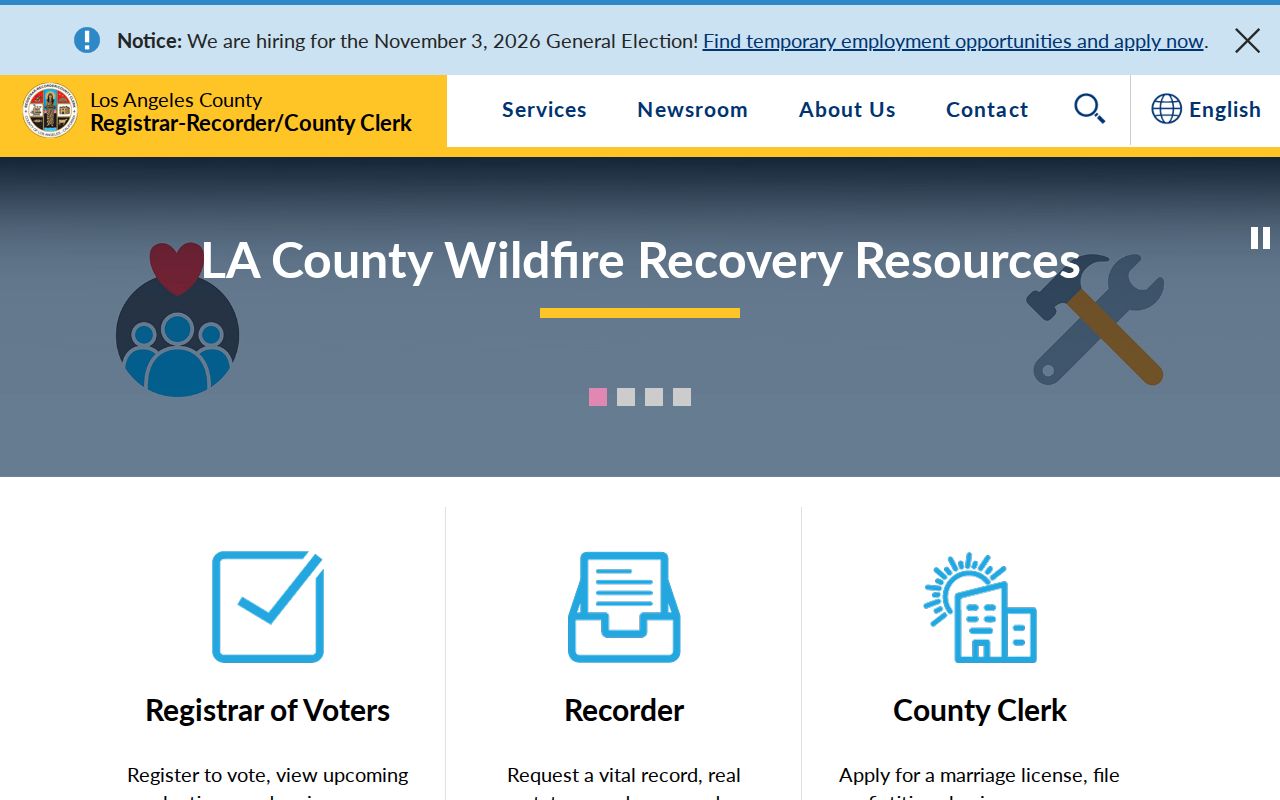
Recorder material can show a chain of title and legal description. It cannot, by itself, prove that every grantee lived at the parcel.
Present-Day Calabasas Directory Sources
Current resident evidence is spread across sources with different purposes. The county parcel card is strongest for the land. A court docket is strongest for a filed case. The voter tool is a self-verification service, not a street browser. City permits can tie a person to a project address for a period, while the City Clerk's staff and agenda pages identify public officials rather than households.
| Source | What it lists | Keeper | Access |
|---|---|---|---|
| Assessor parcel card | Parcel facts and assessed characteristics | Los Angeles County Assessor | Free address/AIN portal; owner channel separate |
| Recorder index | Parties to deeds, liens, and releases | LA County RR/CC | Free office viewing by appointment |
| Voter verification | One voter's registration status | LA County Elections | Subject's last name, birthdate, house number, and ZIP required |
| City permit file | Project address, owner or agent, dates, inspections | Calabasas Building and Safety | Permit account, counter, or public-record request |
| Court case index | Parties, case events, hearings, dispositions | Los Angeles Superior Court | Case number free; name search paid online or free at courthouse terminals |
Business and professional indexes can separate namesakes, but a registered agent, license address, or entity address is a business filing fact. The California Secretary of State's bizfile search returns entity status, formation details, agents, addresses, and filings. The State Controller's unclaimed-property search can add a reported name or location clue, but it is not a current address record. Neither index creates a general Calabasas household directory.
The captured California business search is useful when a name has an entity connection that needs to be checked against a parcel or court result.
Use the business image as a name-disambiguation aid, then return to the record custodian that can answer the actual question.
Official Calabasas Sources and Compiled Tools
Official sources are tied to a custodian and a defined record purpose. A commercial compiled tool can be a pointer to a name or old address, but it may merge namesakes, lag behind a correction, or omit the reason a record changed. Use the official trail for a deed, case, voter status, permit, or certificate.
| Source type | Best use | Check before relying |
|---|---|---|
| County or city custodian | Verify a defined public record | Coverage, exemption, date, and access rule |
| Library or archive collection | Family history and past household clues | Publisher, year, geography, and OCR accuracy |
| Compiled search tool | Generate a lead for lawful personal research | Namesake risk, source date, correction path, and privacy terms |
A compiled result never replaces the Los Angeles County Assessor, RR/CC, Elections, Superior Court, or a library reference answer. For a scam check, compare the supposed record with the official custodian's published phone number and portal rather than trusting an inbound message.
What Calabasas Voter Verification Confirms
The Los Angeles County voter verification form asks for the last name, birthdate, house number, and ZIP code. All four fields are required. The tool is designed for a voter checking their own status. A match confirms information to the subject; it does not expose a list of registered voters on a street, block, or ZIP.
California Elections Code §2194 limits voter-file use to approved political, governmental, scholarly, journalistic, or election purposes. Residence address, phone, email, precinct identifiers, and prior registration details have additional protections. Individual services exist for an own certified copy, another person's permitted certified copy, voter history, and a registration-file search, with separate fees and forms. Mail requests go to the Election Information Section in Norwalk.
The county voter verification form shows the required identity fields used by this part of the Calabasas residents directory.
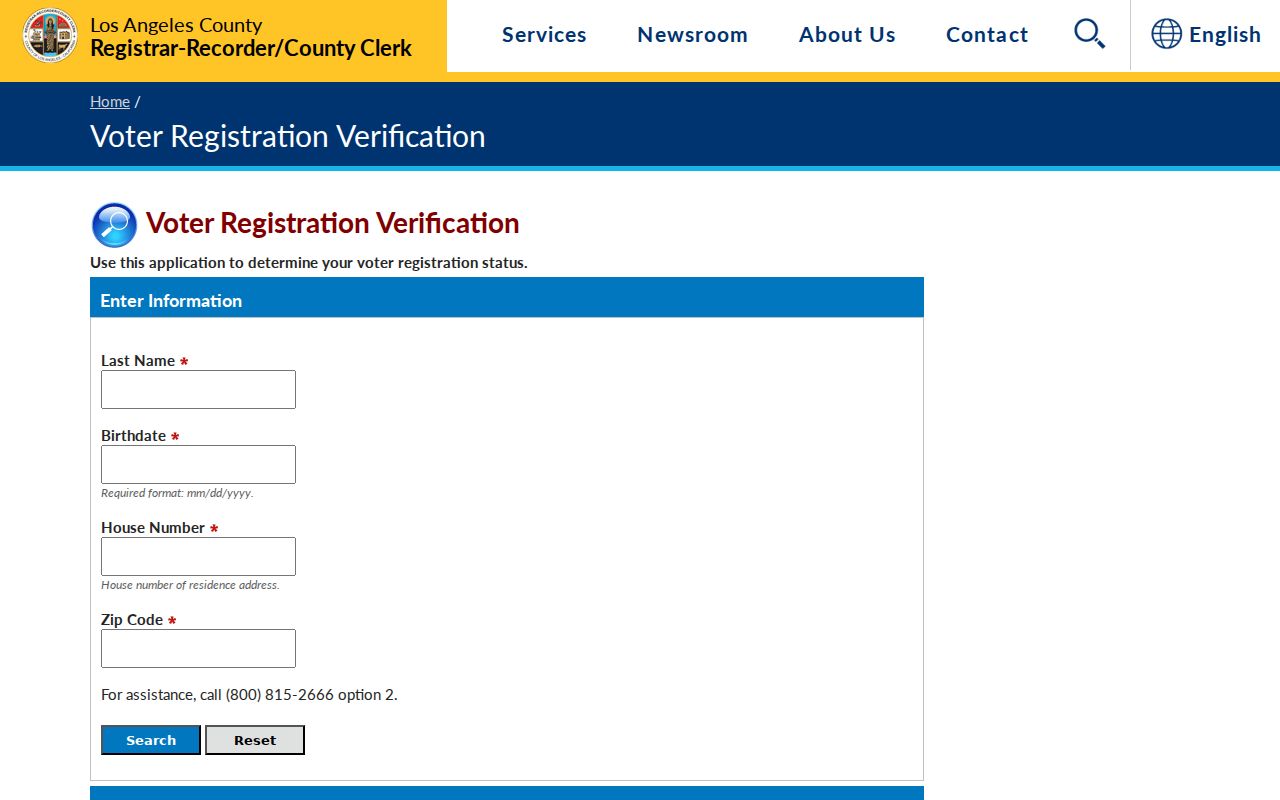
The form's narrow inputs are the point. They prevent the tool from becoming a casual public street roll.
2025 snapshot. The county's December 30, 2025 report listed 16,911 registered voters in Calabasas. That is a dated registration measure, not a count of all residents or households.
Calabasas Vital Records Have Two Copy Types
Birth, death, and marriage questions go through Los Angeles County RR/CC or California Department of Public Health Vital Records. Divorce decrees remain with the Superior Court. California does not use one universal age rule that turns every certificate public. Health and Safety Code §§103525 and 103526 distinguish authorized certified copies from informational copies.
An authorized copy is limited to eligible people and normally requires a sworn statement. An informational copy can be ordered by the public, carries a legend that it is not valid to establish identity, and may redact selected facts. Confidential marriages are available only to a party or by court order. For family research, pair an informational copy or public index with an obituary, cemetery register, church record, or directory rather than trying to bypass a restricted file.
CDPH fees effective January 1, 2026 are $31 for birth, $26 for death, $19 for marriage, and $18 for a dissolution certificate. The agency's processing page stated four to six weeks for certified-copy requests and seven to nine weeks for amendments. Check the current application before sending payment.
Calabasas Permits as Address Evidence
Building and Safety states that permit records are public. A permit can contain the project address, permit and application numbers, valuation, property owner, petitioner, architect, contractor or engineer, contact details, description, issuance date, and inspection dates. The physical permit card can show inspection dates and pass, correction, or fail results.
Permit evidence has limits. Approved residential plans are retained for 90 days after final inspection under Health and Safety Code §19850, and copies of sealed architectural or engineering plans require owner and design-professional authorization. A permit holder can see inspection history through the account. If the file is not online, use the city's request form or call Building and Safety at (818) 224-2534 or BuildingSafetyInfo@cityofcalabasas.com.
The permit's property-owner field can be stale, and a contractor or project contact may never have lived at the address. It is best used to date construction and to find a second record, not as a stand-alone resident result.
Earlier Calabasas Residents in Print
Calabasas incorporated in 1991, so older household research is regional. There is no verified, complete stand-alone Calabasas Polk or criss-cross run in the official web sources. Start with the Calabasas Library catalog, then ask Los Angeles Public Library History and Genealogy staff about Los Angeles regional telephone, city, business, and reverse directories. The Los Angeles County Library Californiana collection in Norwalk and FamilySearch catalog records add other paths.
LAPL's digitized collection spans 1875 through 1987, with Historic City and Business and Phone Directories from 1873 through 1970 and street-reverse volumes for 1906, 1927, and 1956 through 1987. The browse inventory contains 184 items. A search may include county communities, but inclusion of every Calabasas household is not guaranteed. The full collection and search method are treated in the Calabasas city directory page.
Older entries can contain a name, spouse in parentheses, occupation, home address, phone number, widow notation, and cross-reference. Missing an edition does not prove that a person was absent. Unlisted telephones, moves, abbreviations, publication boundaries, and OCR errors all create gaps.
LAPL's digitized-directory page is the regional shelf to test after the local catalog.
Calabasas Directory Search Quirks
OCR searching works best with the printed prefix. LAPL's example uses h443 N Av 52, where “h” marks householder or home and “r” marks residence. Try Avenue, Ave, and Av, as well as Broadway and Bway. Numbered streets may file separately from named streets. A reverse-directory entry is a lead to a listed householder, not a guarantee that every household member lived there.
The 1950 census is free through the National Archives and is the newest open population schedule under the federal 72-year rule. Pair a directory address with the census enumeration district, household relationships, ages, and occupations. If a volume is only on microfilm or in a reference collection, ask staff for a call number and the exact years before drawing a conclusion.
Checking One Calabasas Namesake With Two Records
A same-name match is not identity proof. Preserve the exact spelling, middle initial, suffix, party role, court location, event date, and address relationship. A case result can show the case number, title, filing date, case type, courthouse, parties, hearings, and disposition. Online name searches are paid; courthouse terminals provide a no-fee name-search alternative. Civil image pricing begins at $1 per page for pages 1 through 5, then $0.40 per page, with a $40 maximum per document.
Search the Los Angeles Superior Court Find a Case gateway when the question concerns a filed case, then compare the result with a deed, permit, business filing, or historical entry. A clerk can route a copy request but is not expected to resolve a namesake problem. If the record is wrong, correct it with the custodian that created it.
The captured Los Angeles court gateway shows the case-number, calendar, document, and party-search paths.
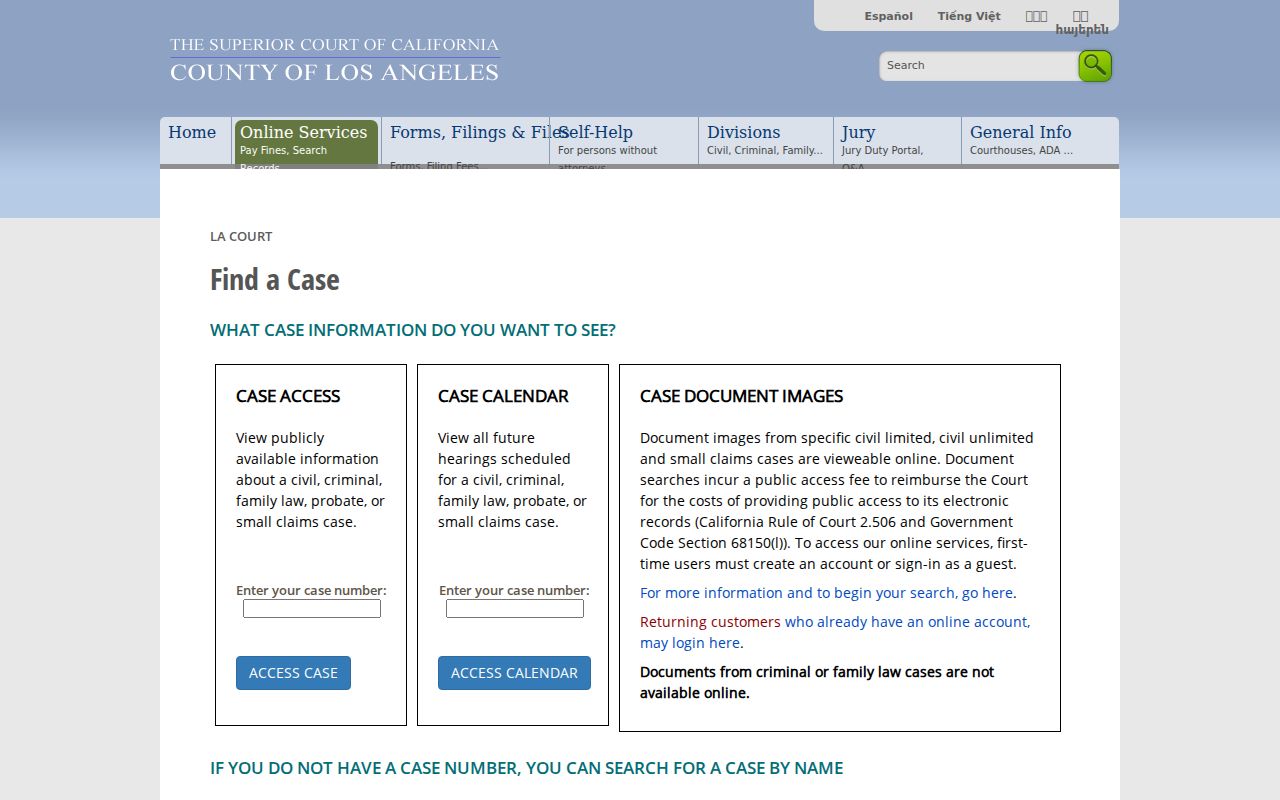
A court index can corroborate a time and identity clue. It does not turn every public filing into a current address record.
- Roll
- A recurring list maintained for a defined purpose, such as assessment or registration.
- Index
- A finding aid that points to a record. It is not the same as the document image.
- Parcel
- A legally described piece of land identified in the county system by an AIN.
- Criss-cross directory
- A reverse directory arranged by address or street rather than only by a person's name.
Calabasas Privacy Boundaries
Some residents will not appear in an ordinary search. California's Safe at Home program provides a substitute mailing address, mail forwarding, confidential voter registration, and service-of-process functions for eligible participants. It does not erase older public records, and a deed's legal description can still identify a parcel. Voter records, DMV information, sealed court files, confidential adoption files, and protected vital-record copies follow their own rules.
California's Public Records Act, Government Code §§7920.000 and following, generally permits inspection of nonexempt state and local records, but a request goes to the agency that maintains the identifiable record. It does not override a special eligibility rule for a vital certificate or voter file. For personal research, family history, civic checking, and scam avoidance, use the narrowest lawful source and respect a missing result.
Lawful personal use. A Calabasas residents directory search is not permission to stalk, harass, intimidate, or publish protected information. California Penal Code §646.9 and related harassment laws can apply to misuse.
A Dated Calabasas Records Story
Two local details show why a dated source matters. RR/CC's restrictive-covenant modification initiative reviews recorded documents from 1850 forward for unlawful discriminatory covenant language while preserving the historic chain through re-recording. Separately, the county's January 21, 2025 wildfire FAQ explains which names, approximate dates, event facts, relationships, and notarized affidavits are needed to recover land and vital records after a disaster.
Those initiatives do not create a new resident list. They show how the records system changes while the underlying trail remains with the custodian. Keep the retrieval date, link, and exact search terms in a family or property research file. When an online path ends, the next step may be a counter, a form, a library reference desk, or an archive rather than another name search.
For a full backward address trail, keep title history separate from occupancy evidence and retain the county's 1851-present recorder coverage in view.